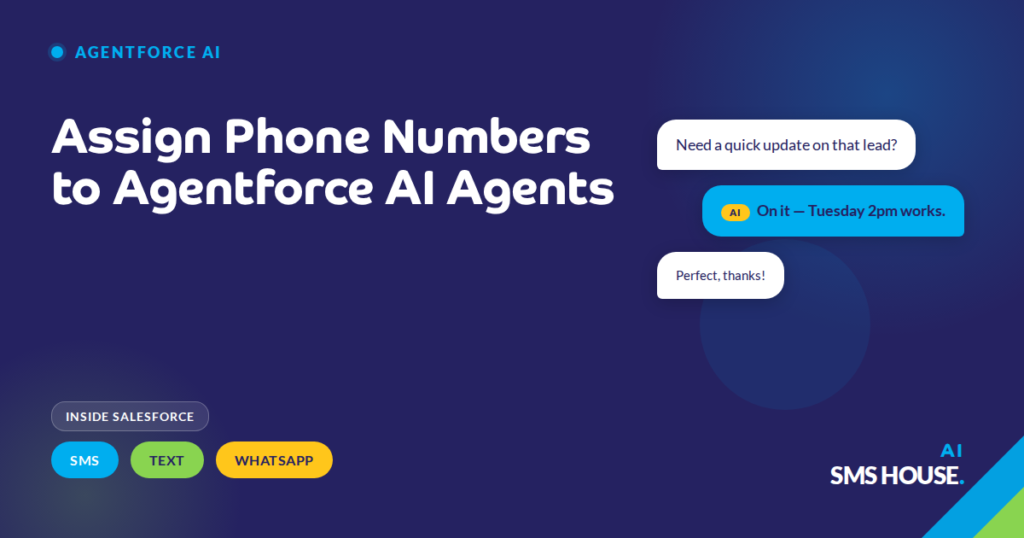
Assign Phone Numbers to Agentforce AI Agents for SMS, Text & WhatsApp
In Agentforce Salesforce, modern organizations use multiple Salesforce AI agents to manage different business functions with clear separation of context and responsibility.
For example, your sales team operates from 9am to 6pm, your support team runs 24/7, and your marketing team sends bulk Salesforce SMS campaigns on specific days like Wednesdays. Each of these workflows can be powered by different Salesforce AI agents , ensuring that conversations remain structured, context-aware, and properly routed within Agentforce Salesforce.
This multi-agent approach keeps messaging streams cleanly separated across sales, support, and marketing while maintaining consistency in Salesforce SMS communication and overall customer engagement.
Why one AI agent on one number isn't enough
With Application House and AI SMS House, your sales Agentforce AI agent is trained to qualify leads by asking about budget, timeline, and decision-making authority. If a customer sends a support request, such as “my login isn’t working,” to that sales number, the message is automatically routed to the appropriate support AI agent or team, ensuring every inquiry is handled by the right agent for the job.
Your different business functions need different AI agent behaviour. A one-agent-fits-all setup means your AI gives sales answers to support customers and support answers to sales prospects. Neither one wins.
How phone number assignment works
Set up multiple business phone numbers for app SMS, text, and WhatsApp from your Salesforce admin panel. Each number can be assigned to Agentforce AI Agents, an AI intelligent agent, or your human team. Inbound messages are automatically routed to the correct AI agent or representative based on the phone number, helping your artificial intelligence agency deliver organized and efficient customer communication.
You’re not building routing logic in code. You’re not training a single mega-AI to handle every scenario. You’re assigning the right agent to the right number, the way you’d assign the right rep to the right queue.
A typical three-number setup
Your real configuration for a mid-sized sales team looks like this:
- +1 (732) 522 7232, Sales AI agent. Qualifies leads, books demos, answers product questions. Hands off to a human when the prospect asks about pricing beyond the published range.
- +1 (732) 522 7233, Support AI agent. Answers account questions, triages tickets, creates Salesforce Cases. Hands off to a human for anything flagged as urgent or upset.
- +1 (732) 522 7234, Marketing bulk-send number. No AI agent attached. Outbound campaign replies route to a monitored queue.
Your one app runs three phone numbers with three different behaviours. Your customer doesn’t care which number they texted, they just get a useful reply, fast.
Different jurisdictions, different numbers
Your US sales team needs a 10DLC-registered number. Your UK sales team needs a UK number that complies with Ofcom rules. Your Agentforce AI agent doesn’t need to know the compliance rules, it just needs to be assigned to the right number for the right market.
Your One AI agent instance, two numbers, two jurisdictions. Your US customer gets a US-compliant reply from a US number. Your UK customer gets a UK-compliant reply from a UK number. Your Salesforce record sees both as the same customer journey.
Why Salesforce users stay in control
Your number assignment sits inside the Salesforce admin setup. You change it in Salesforce. You audit it in Salesforce. You see the AI agent for every conversation in the unified Inbox, filtered by number if you want. Your admin team doesn’t learn a second tool to manage your messaging infrastructure.
Your routing logic is explicit, visible and editable by anyone with the right Salesforce Permission Set. No black boxes, no surprises when a customer asks why they got a weird reply.